
Pending Changes BAFE Look To Be Considering Over The Next 5 Years
What BAFE appears to be considering or preparing over the next 5 years (based on public announcements, recent scheme changes, and likely future directions). I also include some suggestions (i.e. things BAFE or stakeholders could do) that might make sense given the context.
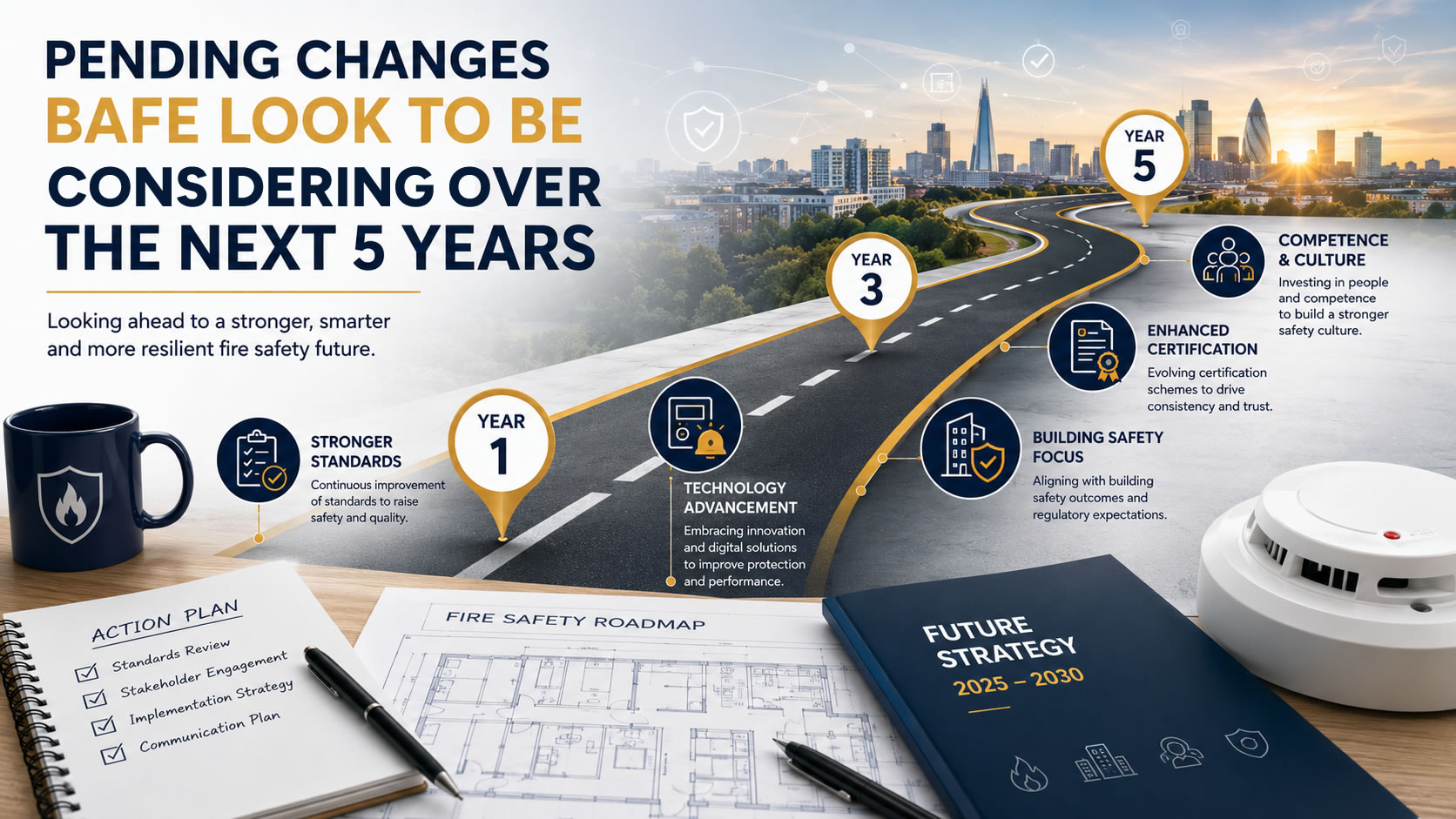
Known / announced BAFE plans & changes
- BAFE recently published BS 8674 — a new competence standard for fire-risk assessors — and is aligning its main scheme with it. The standard defines three levels of assessor competence: Foundation, Intermediate and Advanced.
- In response, BAFE updated its “Life Safety Fire Risk Assessment” scheme BAFE SP205: Version 6.0 was released 7 November 2025.
- Under SP205 v6.0, new competency and qualification requirements are introduced. Fire-risk assessors will need “regulated qualifications” (or equivalent evidence) mapped to the competence levels, depending on how complex the work is.
- The transition timeline is defined: SP205 v6.0 will replace v5.1 as of 31 March 2026.
- Organisations already certified under SP205 have until 31 March 2028 to meet the new regulated qualification requirements.
- The revised scheme document also includes structural/administrative changes: clearer requirements for sole traders, specific application processes, stricter rules for subcontracting (all subcontractors must themselves be third-party certificated)
- BAFE emphasises independent, third-party certification via a UKAS-accredited Certification Body as the means to assure competence and quality.
What BAFE (or the sector) is likely to focus on in next 5 years
- Rolling out the new competence-based qualification framework: as regulated qualifications become more widespread (e.g. through awarding bodies such as those referenced by BAFE) and more assessors move to Foundation/Intermediate/Advanced levels.
- Increasing uptake of third-party certification and auditing; possibly raising the number of on-site audits / surveillance audits to maintain high standards (especially now that SP205 requires more robust verification).
- Applying the SP205 / BS 8674 model more broadly across different types of premises and fire-risk assessors — including sole traders, small firms, subcontractors — due to the clarified application process.
- Working with regulators / government to support potential legislation requiring minimum competency for all fire-risk assessors (especially after criticisms raised in earlier fire-safety inquiries).
- Ongoing updates & reviews of BAFE schemes to align with evolving standards, building regulation, and fire-safety best practice (i.e. BAFE signalling it will “continue to review schemes against new requirements”).
Suggestions / What BAFE (or stakeholders) should consider doing
- Enhanced transparency and public guidance: Produce clear, publicly accessible guidance for building owners, landlords, and responsible persons — explaining what BAFE certification means, why BS 8674 competence levels matter, and how to choose a properly qualified fire-risk assessor.
- Improved training & qualification access: Work with awarding bodies and training providers to expand capacity, ensure regulatory-aligned courses are affordable and available — including for sole traders and smaller firms — to avoid a shortage of qualified assessors.
- Phased implementation & support: Offer support programmes for existing SP205-certified organisations to transition to v6.0 — including mentoring, “pre-audit” checks, and flexibility for smaller businesses.
- Promote regular re-assessment / CPD requirements: Encourage or mandate periodic re-certification / continuing professional development for fire risk assessors to ensure competence remains current, especially in a changing regulatory/environmental context (new building types, regulations, technologies).
- Encourage wider adoption across fire-safety services: Use the competence/qualification model as a blueprint for other fire-safety schemes (not just risk assessment) — e.g. fire-alarm installation, maintenance, fire-safety consultancy — to raise overall sector standards.
- Engage with government/regulators: Work proactively with regulatory bodies and policymakers to push for formal recognition of competence requirements (e.g. via regulation or legislation), ensuring that fire-risk assessment competence becomes mandatory rather than voluntary.
| Time Period | Expected Milestones / Focus |
|---|---|
| Now – 2026 | Full rollout of SP205 v6.0; organisations begin transition; new registrations under v6.0; early adopters get qualified. |
| 2026 – 2028 | Certificated organisations complete regulated-qualification requirements by 31 March 2028. Wider education/training uptake; new generation of assessors trained under BS 8674 framework. |
| 2028 – 2030 | Maturing of competence-based assessment culture; increasing third-party audits; possible push for regulatory/legislative requirement for certified assessors. Smoother, more consistent fire-risk assessment service across UK. |
| Beyond 2030 | Fire-safety industry operating under a regulated, competence-based standard; continuing updates of schemes; potential expansion to related fire-safety services. |
Strategic Recommendations for BAFE – 5-Year Plan (2025–2030)
- Introduce a unified “Fire Safety Competence Register”
A single, publicly accessible register listing:
- All BAFE-certified organisations.
- Each assessor’s BS 8674 competence level (Foundation / Intermediate / Advanced).
- Renewal dates, qualifications, and audit history.
- This would dramatically improve transparency for responsible persons and tenants.
- Improve consumer-facing guidance for building owners & managers
Create plain-language guides and short videos explaining:
- What third-party certification means.
- How SP205 v6.0 affects them.
- How to verify assessor competence.
- This would reduce confusion and raise industry-wide standards.
- Create a national outreach programme for SMEs and sole traders
Smaller organisations may struggle most with new competence and qualification requirements. BAFE could provide:
- Subsidised training access.
- Step-by-step transition packs.
- Readiness assessments before certification audits.
- This protects both small businesses and the quality of the UK’s fire-risk assessment work.
- Introduce mandatory CPD requirements across all schemes
Recommendation: minimum 20 hours CPD per year for every certified assessor/technician.
This would ensure that skills stay current as building technologies, safety standards, and legal requirements evolve.
- Expand the competence-based model to all BAFE schemes
SP205 has adopted BS 8674’s competence structure — but other schemes (alarms, emergency lighting, portable extinguishers, etc.) could also benefit from:
- Clearer skills and knowledge levels.
- Regulated qualification pathways.
- Transparent evidence of competence.
- This would unify standards across the fire-safety industry.
- Develop a digital audit and verification system
A secure online portal where:
- Certification bodies upload audit results.
- Organisations track compliance tasks.
- Responsible persons verify certificates instantly.
- This reduces fraud and administrative errors while improving trust.
- Work closely with government toward regulated minimum competence
BAFE is well positioned to support the push for legislation requiring:
- Minimum recognised qualifications.
- Mandatory third-party certification for fire-risk assessment.
- Defined competency levels for assessors on different building types.
- This would bring fire risk assessment closer to the standards seen in gas, electrical, and structural safety.
- Publish an annual “State of UK Fire Competence” report
A yearly publication summarising:
- Number of certified organisations.
- Compliance trends.
- Audit failures.
- Uptake of regulated qualifications.
- Sector challenges and recommendations.
- This would give policymakers and industry leaders data-driven insight.
Our team aims to deliver expert customer care, from site survey to completion through to ongoing maintenance. Developing a lasting relationship with a partner you can trust to protect you and your premises whilst ensuring your businesses and organisations are fully compliant to the latest legal requirements. We are CHAS accredited, BAFE registered and, SSAIB certificated with BS EN ISO 9001:2015 & Construction Line approved, so your organisation can be assured that all our fire, security and safety equipment is designed, supplied, installed and maintained in accordance with the latest British Standards.
#BAFE #FireAlarms #FireRiskAssessment #FireSafetyEquipment #FireAlarmMaintenance #AccessControl #CCTV #SSSystems
