
Five Potential/Impending Changes In Access‑Control & Their User Impact
Access control is entering one of its most significant periods of transformation in decades. Once centred on keycards, PINs and standalone security systems, today’s access-control technologies are increasingly shaped by biometrics, cloud-based platforms, mobile credentials, artificial intelligence and the growing demand for trusted digital identities. At the same time, evolving UK legislation, regulatory scrutiny and industry guidance are redefining how organisations collect, manage and protect the personal data that underpins these systems.
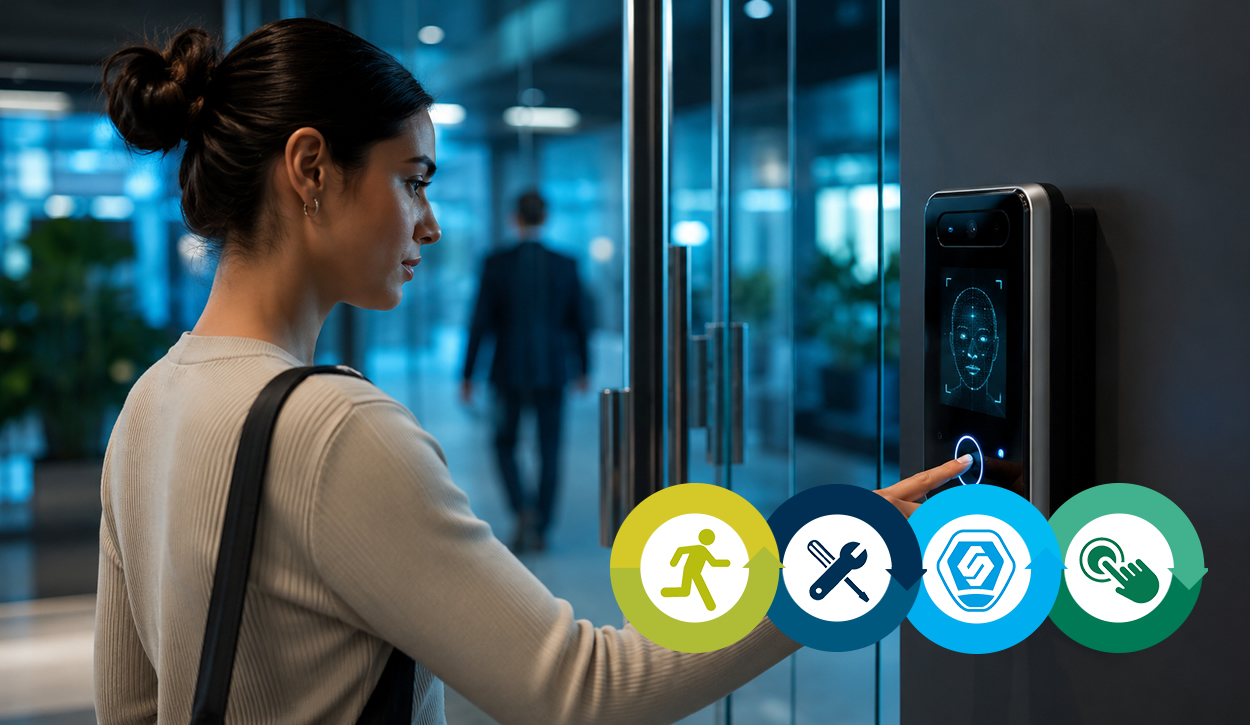
Against this backdrop, businesses responsible for securing people, property and information must prepare for a new generation of access control that promises greater convenience and intelligence, but also introduces fresh challenges around privacy, cybersecurity, compliance and user trust. Here are five impending changes that are likely to reshape the access-control landscape—and what they could mean for users over the coming years.
- Legal/regulatory change from Data (Use and Access) Act 2025 (DUAA) and related data‑protection reform
What’s changing:
- DUAA reforms the UK data‑protection regime: it introduces a new lawful basis of “recognised legitimate interest” for processing personal data, potentially making it easier to store and use biometric or access-control data for purposes like security, crime prevention, safeguarding, facility management.
- The Act also relaxes some restrictions on automated decision‑making (ADM) for nonsensitive data opening the door for more automated access control (e.g. biometric authentication, automated entry‑logging) without prior explicit consent under certain conditions.
- At the same time, there are stricter compliance requirements: organisations must handle data access requests more carefully (reasonable & proportionate data subject access requests), maintain complaint procedures and adhere to data‑handling duties if storing personal or biometric data.
Impact for end‑users:
- Access‑control operators (buildings, offices, landlords) may adopt biometric systems or automated entry systems more broadly meaning you might increasingly encounter fingerprint, facial‑recognition, or mobile‑credential access instead of keys/cards.
- Because data‑processing becomes easier under “legitimate interest,” your access data (who entered when, biometric info, logs) may be stored longer and used more widely (for security, audits, or investigations) reducing privacy unless data‑use policies are robust.
- Users may find it easier to be locked out if biometric data is mis‑handled, lost, or mis‑matched. Also, you may have fewer rights to challenge automated decisions if ADM is used to control entry or flag suspicious behaviour unless safeguards are strictly followed.
- Growth of Cloud‑Based & App‑Centric Access Control Systems
What’s changing:
- The access‑control industry is shifting from traditional on‑site systems (turnstiles, card‑readers, physical key management) to cloud‑based solutions: credentials, access logs, permissions can be managed remotely across multiple sites.
- This also means easier scalability and flexibility: landlords, employers or building managers can grant or revoke access remotely, change access permissions dynamically, and deploy updates and patches without on‑site intervention.
Impact for end‑users:
- Convenience: easier entry (maybe via phone app, mobile credential, or remote provisioning), no need to carry physical keys/cards, and small changes (e.g. a new tenant, visitor access) can be handled quickly.
- Faster management of lost credentials: if you lose a phone or access card, access can be disabled remotely improving security.
- Risk: reliance on internet connectivity and cloud servers could become a point of failure e.g. if the cloud service is down, or if there’s a data breach. Users may also worry about how long their access logs are stored, who can access them, and whether the system is secure.
- Wider Adoption of Biometric & Multimodal Authentication Systems (fingerprint, face, iris, etc.)
What’s changing:
- The industry is increasingly adopting biometric authentication fingerprint, facial recognition, even iris or multimodal biometrics as standard in modern access control for heightened security and convenience.
- There is growing use of “multimodal biometrics” (multiple biometric factors together) to reduce false positives/negatives and improve identity verification reliability.
Impact for end‑users:
- Greater convenience: no need for keycards or remembering PINs access by fingerprint or face can be quicker and more seamless.
- Stronger security: biometric identifiers are harder to fake or lose than physical keys/cards, reducing risk of unauthorised access.
- Privacy and data‑protection concerns: biometric data is sensitive. Users may be worried about how long the data is stored, who can access it, whether it can be shared, and what happens if there’s a breach. Also, biometric matching errors can lock people out or wrongly deny access.
- Integration with Other Security & Building Systems (CCTV, visitor management, alarms, occupant‑tracking)
What’s changing:
- Access‑control systems are increasingly being deployed not standalone but as part of integrated security ecosystems combining access control with CCTV, intruder alarms, fire detection, visitor‑management, and building management systems.
- AI/ML and automation: some systems use AI to detect anomalous access patterns, trigger alerts (e.g. unusual entry times, repeated failed attempts), and orchestrate cross‑system responses (lockdown, CCTV recording, security alerting).
Impact for end‑users:
- Improved safety and security overall combined systems can help detect security incidents faster, log events automatically, and manage spaces more effectively (especially in residential blocks, offices, or shared facilities).
- Enhanced monitoring: your entry, exit, and time-in/building movements could be logged more comprehensively good for security, but potentially invasive from a privacy standpoint.
- More complexity: with integrated systems, malfunctions or errors might have broader consequences (e.g. a fault in one subsystem could affect building access, CCTV recording, or visitor management simultaneously).
- Use of AI / Machine Learning for Behavioural‑Based Access Control and Adaptive / Context‑Aware Permissions
What’s changing:
- AI and machine learning are increasingly being incorporated into access‑control systems to provide “smart” features: pattern recognition (e.g. regular user behaviour), anomaly detection (e.g. unexpected access outside hours), adaptive access (grant or restrict access depending on risk, time, location), and intelligent logging/reporting.
- These systems may be able to dynamically adjust access permissions (e.g. limit access for certain users when unusual activity is detected) or trigger alerts / lockdown procedures automatically.
Impact for end‑users:
- Increased security: potential to catch and prevent unauthorised access or suspicious behaviour in real time — which can protect residents, employees, or property.
- Less control / transparency: automated systems may act (deny entry, trigger alarms) based on algorithms rather than human judgement, which can lead to false positives/negatives. Users may find it harder to challenge or understand why access was denied.
- Privacy and fairness concerns: collecting and analysing users’ access patterns might feel intrusive; decisions about who can enter when may become opaque and possibly discriminatory if not carefully managed.
Overarching Trade‑offs & What Users Should Watch Out For
- Security vs Privacy: The more secure and intelligent access systems become, the more personal data (even biometric) is collected, stored, and used. For end‑users, this raises questions about data retention, consent, transparency especially in residential or shared‑space contexts.
- Dependence on technology: Cloud‑, AI‑, and biometric‑based systems may improve convenience but also introduce risks: outages, software bugs, breaches, or loss of data can lock people out or expose personal information.
- Consent & control: As systems rely more on “legitimate interest” and automated processing (under DUAA), individuals may have fewer opportunities to consent or object especially if biometric access is mandatory.
- Accountability and transparency: With integrated and automated systems, it may become harder to know who controls the access logs, who can view or act on them, and how long data is retained.
- Equality and fairness: Biometric or AI‑driven access control may inadvertently discriminate or mis-identify e.g. biometrics less accurate for certain demographic groups, or algorithms mis‑flagging behaviour as suspicious.
Several recent UK‑based or UK‑relevant regulatory/industry reports and analyses (2024–2025) that shed light on trends and pending changes in access‑control especially around biometrics, cloud/IoT, data law changes useful for anticipating how “access control” will evolve.
Recent Reports & Industry Analyses
| Source / Report | What it Covers / Why It Matters |
|---|---|
| Digital Identity Sectoral Analysis 2025 (UK government) | Reviews the state of digital‑identity, identity‑verification and authentication services in the UK, including use cases such as “secure access management.” It documents growing consolidation (acquisitions), growth in identity‑verification firms, and expanding use of identity systems beyond banking/finance (e.g. tenant screening, sign‑on, access). |
| Physical Access Control Market 2025–2035 Outlook (Industry Today / market‑analysis report) | Projects a global / UK‑relevant growth in physical access‑control demand driven by increasing security needs, IoT and smart‑building integration, and adoption of biometrics. Emphasises convergence of access control, building automation and IoT systems. |
| Access Control Trends in 2025 (Business Watch Group, UK‑based) | Analyses contemporary shifts: broader adoption of biometric access (fingerprint, face, iris), mobile access credentials, cloud‑based management of access rights, remote credential provisioning — i.e. making access control more flexible and scalable. |
| Top Security Trends for UK Businesses in 2025 (Direct Defence Solutions / security‑industry commentary) | Describes increasing convergence of access‑control systems with CCTV, alarm, and visitor‑management systems; signals that many UK businesses are moving away from traditional keys/cards to “smart” multi‑factor or biometric access. |
| UK Cybersecurity Sector Report 2024–2025 (UK Department for Science, Innovation & Technology / sector statistics) | Shows that UK cybersecurity — including digital identification, authentication, and access‑control firms — has grown significantly (revenues and workforce up). This points to increased demand for secure access & identity‑management solutions, likely reflecting rising adoption of advanced access‑control technologies across sectors. |
What These Reports Together Suggest About What’s “Pending” or Likely to Grow for Access Control
From the recent reports and market‑analysis, the following trends (some already underway) seem likely to shape the next few years supporting some of the “potential changes” previously listed:
- Growing shift from traditional locks/cards to biometric and multi‑factor access control systems (fingerprint, face, iris, mobile credentials).
- Increase in cloud‑based and IoT‑integrated access control enabling remote, centralised management of access rights, easier onboarding/revocation, multi‑site control, and integration with other building systems (alarms, CCTV, visitor management).
- Rising market demand for “smart buildings” access control becoming part of larger building‑management ecosystems (security, energy, building automation) rather than stand‑alone door locks.
- Pressure from regulatory and data‑legal developments (e.g. under the Data (Use and Access) Act 2025) encouraging or requiring more secure, auditable, and privacy‑conscious identity and access‑management systems.
- A matured cybersecurity/access‑control sector in the UK, with more firms, investment and capability making advanced access‑control solutions more available, affordable and scalable.
Broader Implications from These Reports
- Access control and identity verification are evolving from niche or high‑security uses (banks, data‑centres) to mainstream applications: workplaces, apartment blocks, co‑living/office‑sharing, public‑private buildings, maybe even digitally managed residential developments.
- As access‑control becomes part of broader infrastructure (cloud, IoT, building automation), the distinction between “cyber‑security” and “physical security” blurs — meaning breaches, misconfigurations or failures may have both digital and physical safety consequences.
- The pace of growth in biometric and cloud‑based access control suggests the next generation of systems will likely emphasise flexibility, scalability, audit‑trail / logging, remote management, and integration beneficial for building managers and users but also requiring strong data‑protection compliance and transparency.
- Regulatory change (e.g. data‑law updates) and public‑sector / private adoption of digital‑identity infrastructures will likely increase trust and standardisation but also raises the bar for privacy safeguards, oversight, and user rights (data access / deletion / auditability).
Find out more at https://sssystems.co.uk/access-control/.
Our team aims to deliver expert customer care, from site survey to completion through to ongoing maintenance. Developing a lasting relationship with a partner you can trust to protect you and your premises whilst ensuring your businesses and organisations are fully compliant to the latest legal requirements. We are CHAS accredited, BAFE registered and, SSAIB certificated with BS EN ISO 9001:2015 & Construction Line approved, so your organisation can be assured that all our fire, security and safety equipment is designed, supplied, installed and maintained in accordance with the latest British Standards.
#AccessControl #SmartAccessControl #AccessControlSystems #AccessControlMaintenance #CCTV #SSSystems
