
Fire Alarm & Fire Detection Equipment Expected To Evolve In The Next 5 Years
Fire-alarm and fire-detection equipment is evolving quickly. We have created a summary of what can we expect to change during the next 5 years. Before diving into future innovations, it helps to understand the near-term changes already affecting fire-alarm equipment. These set the baseline against which new developments will emerge.
Recent Developments & Shifting Standards in the UK
The UK’s principal standard for fire detection & alarm systems in non-domestic buildings was updated: BS 5839-1:2025 replaced BS 5839-1:2017 — bringing in substantial new requirements for design, installation, maintenance, monitoring and fault signalling.
- Key updates under BS 5839-1:2025 include:
- Preference for smoke detectors (not just heat detectors) in sleeping accommodation (e.g. bedrooms, care-home rooms, student housing) for faster fire detection. I
- Clarified and tightened rules on system categories (L1–L5), detection coverage (escape routes, lift shafts, vertical shafts), and detector placement (considering architectural obstructions like beams or ducting to avoid “shadow zones”).
- Stricter requirements for monitoring and fault signalling: e.g. automatically monitored systems must transmit an alarm activation to a monitoring centre within 90 seconds, and report faults within 3 minutes.
- Enhanced maintenance and documentation standards: engineers must perform regular checks (battery, panel clock, remove decommissioned detectors, update zone charts), and personnel competence / CPD (continuing professional development) is emphasised.
- Mandatory labelling and “False Alarm” indication on panels that are linked to fire & rescue services — to encourage careful management and reduce nuisance activations.
- These changes indicate that the baseline for fire-alarm systems is already rising more rigorous design, better detection coverage, faster monitoring, improved maintenance, and stronger competence requirements.
Key Trends and Technological Innovations in Development (2025–2030)
Beyond standard compliance, several broader technology and industry trends are reshaping fire-alarm equipment and pointing toward likely improvements over the next 5 years. Many of these are already in early adoption; others are emerging.
- Smart / Enabled Fire Detection & Monitoring
- Fire-alarm control panels and detection systems are increasingly becoming IoT-enabled, meaning they connect to the cloud, can report status remotely, send real-time alerts to mobile devices, and enable centralised monitoring of multiple buildings or sites.
- This connectivity allows building managers, facility teams, or alarm monitoring centres to access system status, logs, and event history remotely, rather than relying solely on local panels or on-site checks.
- For multi-site organisations (e.g. chains of offices, student accommodation blocks, care-home networks), such centralised oversight can make maintenance and compliance significantly easier and more consistent.
Implication: Over the next few years, enabled fire systems should become standard in many commercial and high-risk residential buildings — increasing reliability, lowering oversight burden, and enabling faster, coordinated responses.
- Multi-Sensor & Hybrid Detectors (Smoke + Heat + Gas + Environmental Data)
- Traditional fire detectors often rely on a single modality (e.g. smoke or heat). But newer “smart detectors” combine multiple sensing criteria — smoke density, rate of temperature change, CO or gas detection, humidity/airflow/humidity, etc. This helps the system better differentiate between a true fire and benign triggers (steam, dust, cooking fumes, etc.).
- Multi-sensor detectors reduce false alarms significantly, an important benefit in occupied buildings, reducing unnecessary evacuations and response calls, and improving trust in the system.
- In some advanced research prototypes although not yet mainstream, scientists are exploring novel sensor materials — for instance, a system using flame-retardant cellulose paper loaded with graphene oxide and MXene to achieve very fast temperature-response detection, paired with wireless signal conversion for remote alerting.
- Implication: Over the next 3–5 years, as multi-sensor detectors become more affordable and widely adopted, fire detection will become more accurate, faster, and less prone to nuisance triggers — improving safety and reducing disruption.
- Integration with Building Management & Security Systems (Smart Building / Smart Safety Ecosystem)
- Modern fire-safety solutions are increasingly being integrated with other building systems: CCTV, access control, intruder alarms, building-management systems (HVAC, ventilation, lift control), automated suppression, emergency lighting, etc. This “holistic safety ecosystem” approach enables coordinated response — e.g. unlock exit doors automatically, shut down ventilation, activate escape lighting, notify monitoring centre & fire brigade.
- Integration simplifies management for facility operators: rather than stand-alone systems in silos, a unified platform gives comprehensive visibility and control, particularly important in complex buildings (multi-storey residential blocks, hotels, hospitals, care homes, mixed-use developments).
Implication: In the near future (2026–2030), many new buildings — and even retrofits — will favour integrated fire + security + building-management systems. This trend should improve emergency response coordination and overall safety.
- Cloud-Based & Remote Monitoring, Diagnostics & Predictive Maintenance
- With IoT connectivity and cloud platforms, fire alarm systems can now provide real-time diagnostics: system health, battery status, last test, fault conditions — accessible remotely.
- This supports predictive maintenance (rather than just scheduled checks): anomalies (drifting sensors, humidity changes, repeated near-fault events) can trigger maintenance actions pre-emptively — reducing the chance of alarm failure when needed.
- For large organisations or landlords with many properties, this reduces the overhead and increases reliability.
Implication: By 2030, “smart maintenance” will likely be the norm, improving system uptime, compliance, and reducing risk of undetected failures — especially important in high-risk or multi-occupancy properties.
- Artificial Intelligence & Predictive Analytics for Fire Risk & Alarm Interpretation
- AI / ML (machine learning) is increasingly being integrated into fire-alarm and detection systems to help in real-time anomaly detection (recognising real fire events vs benign triggers), false-alarm reduction, and to add predictive capability — for instance, flagging overheating machinery or environmental conditions trending toward fire risk.
- AI can analyse data from multiple sensors (smoke, temperature, humidity, CO, airflow) plus historical data, building layout, occupancy patterns, to make smarter judgments about when to raise an alarm — rather than relying on fixed threshold triggers.
- In complex buildings (industrial, storage, data centres, mixed-use), this can significantly improve detection reliability, reduce false alarms, and enable earlier intervention (e.g. before fire spreads).
Implication: By 2028–2030, AI-driven fire detection could become standard in large-scale or high-risk buildings — transforming fire safety from reactive to proactive and significantly improving early-warning capabilities.
What’s in the pipeline for improvement in the Next 5 Years
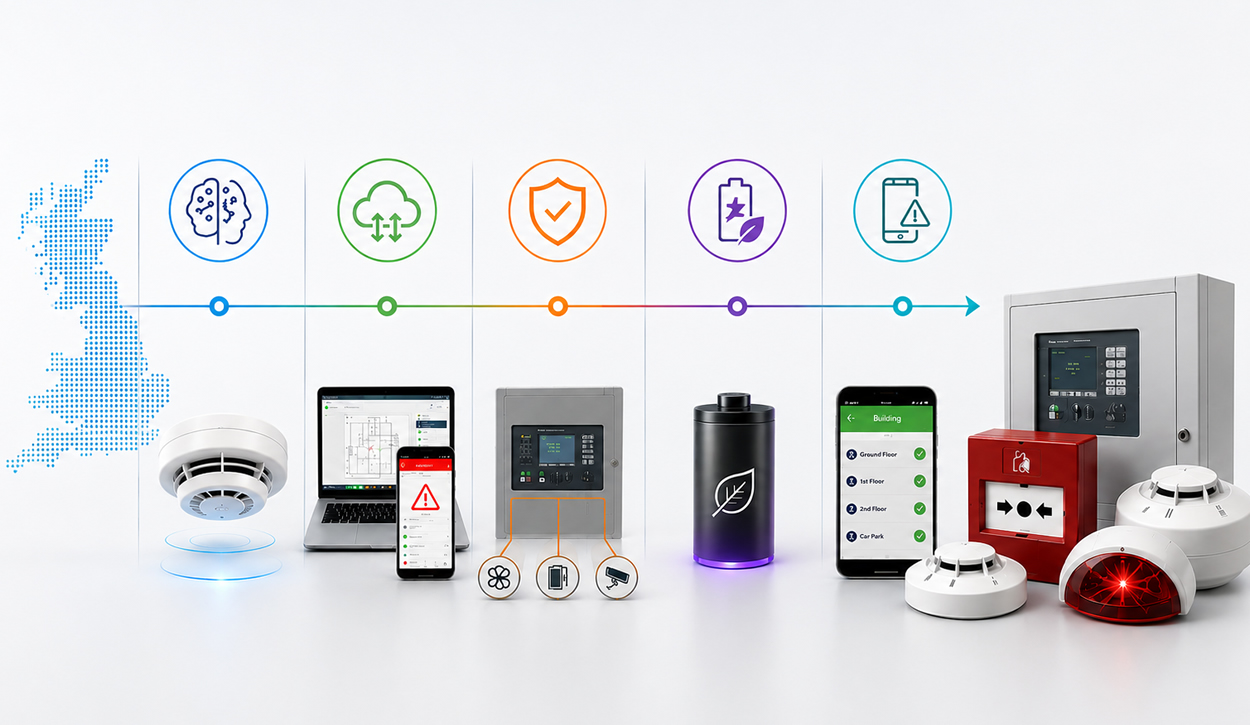
Based on existing trends, technological research, and regulatory pressure, here’s a forecast of likely improvements / innovations for fire-alarm equipment in the UK by 2030:
| Improvement / Innovation | Likely Impact / Benefit |
|---|---|
| Widespread adoption of IoT-enabled panels & cloud monitoring | Centralised management, remote alerts, multi-site oversight, faster reactions, better compliance tracking |
| Deployment of multi-sensor & hybrid detectors (smoke + heat + CO + environment) | Earlier detection, fewer false alarms, better performance in challenging environments (kitchens, basements, dusty or humid areas) |
| Increase in integrated safety ecosystems (fire + security + access + building controls) | Coordinated responses, improved evacuation, reduced damage, better overall building safety |
| Use of predictive maintenance + remote diagnostics | Lower system downtime, early detection of faults, cost savings, improved reliability |
| Use of AI / ML analytics for fire detection & risk forecasting | More accurate detection, fewer false alarms, predictive risk identification, improved safety in complex buildings |
| Smart integration with occupancy / environmental sensors (e.g. HVAC, CO₂, airflow, humidity) | More context-aware detection, earlier warnings, adaptability to building use patterns |
| Adoption of wireless and battery-powered detectors with long-life / low-power IoT connectivity | Easier retrofit, lower installation cost, suitability for residential buildings, heritage buildings, hard-to-wire sites |
| Enhanced accessibility features: e.g. visual alarm devices (VADs), combined smoke + CO detection, occupant-friendly alerting (smartphone alerts, remote notifications) | Improved occupant safety, better compliance with inclusive design standards (for deaf/hard-of-hearing persons), modernisation of residential fire safety |
| Standardisation of remote-data logging & compliance documentation | Easier maintenance/fault history tracking, simplified audits, better regulatory compliance, insurance certainty |
| Faster response & monitoring protocols — as required under newer standards (e.g. signalling watchdogs, fault logging, automatic monitoring) | Reduced alarm-to-response time, quicker fault detection, improved reliability for life-safety systems |
What is Holding Some Innovations Back — Challenges & Barriers to Adoption
While many of these innovations show promise, full adoption across the UK will face some constraints:
- Regulatory lag & standard harmonisation: Standards like BS 5839-1 must catch up with rapidly evolving tech (IoT, AI, cloud). Retrofitting existing buildings to meet updated standards can be expensive.
- Cost: Multi-sensor detectors, IoT panels, monitoring subscriptions, smart integrations — while increasingly affordable — remain more expensive than basic smoke/heat alarms. This may slow adoption, especially for smaller properties.
- Legacy building constraints: Older buildings (listed, historical, hard-to-wire) may find wiring or retrofitting difficult; wireless / IoT detectors help, but adoption is slower.
- Cybersecurity & data protection risks: As systems connect to cloud/Internet, they become vulnerable to hacking, tampering, or data breaches — requiring robust security protocols which raise complexity and cost.
- Maintenance & competence requirements: Advanced systems need qualified installers, regular maintenance, and periodic software updates; this increases demand on competent providers and ongoing management overhead.
- False sense of security: Complex systems may give a false sense of safety if not properly maintained or misconfigured — human factors remain critical.
What This Means for UK Building Owners, Landlords, Managers & Policymakers
- For new builds or major refurbishments: It makes sense to specify smart, IoT-enabled, multi-sensor fire systems — they will likely become the norm.
- For existing buildings: Consider phased retrofit: start with critical zones (sleeping areas, escape routes), migrate alarm signalling to monitored/cloud-based, and gradually upgrade detectors.
- For high-risk or multi-occupancy properties (care homes, student housing, HMOs, hotels, hotels, mixed-use flats): invest in integrated, monitored, multi-sensor, and AI-assisted detection + monitoring + documentation to meet future compliance and safety standards.
- For regulators/policymakers: Encourage or mandate adoption of modern fire-detection standards — particularly for sleeping accommodation and high-risk residences, while ensuring accessibility, maintenance, and competence expectations keep pace.
- For insurers: Push for certified, smart systems with maintenance logs and remote monitoring — this reduces risk, claims, and improves reliability.
Our team aims to deliver expert customer care, from site survey to completion through to ongoing maintenance. Developing a lasting relationship with a partner you can trust to protect you and your premises whilst ensuring your businesses and organisations are fully compliant to the latest legal requirements. We are CHAS accredited, BAFE registered and, SSAIB certificated with BS EN ISO 9001:2015 & Construction Line approved, so your organisation can be assured that all our fire, security and safety equipment is designed, supplied, installed and maintained in accordance with the latest British Standards.
#FireAlarms #FireRiskAssessment #FireSafetyEquipment #FireAlarmMaintenance #AccessControl #CCTV #SSSystems
