

Sample Evacuation Plan & How It Might Look Like For A Commercial Building
Here is an UK-oriented overview of what a robust commercial property fire-alarm evacuation plan should cover, including legal/compliance context, what an “expected” evacuation timeline might look like (with many caveats), and a sample comparison table using a hypothetical commercial building.
Legal & Regulatory Framework (UK)
Key Legislation & Duties
- The cornerstone is the Regulatory Reform (Fire Safety) Order 2005 (FSO). Under this, the “responsible person” (e.g. business owner, landlord, employer) must carry out a fire risk assessment, ensure adequate fire detection and alarm systems, maintain clear means of escape, and establish evacuation procedures.
- Guidance for small non-domestic premises is given in A guide to making your small non‑domestic premises safe from fire (for simpler workplaces).
- More complex or larger buildings need bespoke, documented evacuation plans — including layout, escape routes, alarm systems, staff responsibilities etc. Many fire-risk assessments follow methodology from PAS 79.
- For residential (or mixed) buildings above a certain size/height, the newer Fire Safety (England) Regulations 2022 requires floor-by-floor plans, building plans, location of firefighting/lift/equipment, and sharing with the fire service.
What an Evacuation Plan Must Include
According to guidance and FSO requirements, a compliant evacuation plan should clearly cover:
- A written fire-risk assessment (identifying hazards, who is at risk, control measures).
- A fire detection and warning system appropriate to the size, use, and occupancy of the building (e.g. smoke/heat detectors, manual call points, alarm panels).
- Designated and maintained escape routes and exits — corridors, stairways, final exits must be unobstructed, clearly signed, lead direct to a place of safety.
- Emergency lighting and signage where necessary (especially in corridors, stairwells, exits).
- An “emergency procedure” / fire-action plan: what happens when alarm sounds — including evacuation strategy (simultaneous full evacuation or phased), responsibilities (fire wardens / staff), assembly points, communicating with fire service, and arrangements for assisted evacuation if needed (e.g. for disabled occupants).
- Regular maintenance, testing, and record-keeping for alarms, escape routes, lighting and training.
Failure to comply can lead to enforcement action, fines and more dangerously, increased risk to life.
Evacuation Strategy & “Expected Times” What Influences Them
Estimating how long it takes to evacuate depends heavily on building size, layout, occupancy, type of industry/activity, mobility of occupants, and evacuation strategy. There is no universal “standard time” that applies to all buildings. However, some guidance and empirical data provide useful benchmarks and influencing factors:
- For smaller care-home type “protected zones”, the older government (CLG) guide suggested aiming to evacuate a protected area in about 2.5 minutes under ideal conditions.
- That 2.5 min is regarded as a starting point — many care homes and similar premises find that achieving it is not realistic depending on staff numbers, residents’ mobility, time of day (e.g. night), layout etc.
- More generally, total evacuation time for larger multi-storey (e.g. >10 floors) buildings cannot simply be scaled by floor count: stairwell capacity, congestion, human behaviour (pre-evacuation delay — people finishing tasks, retrieving belongings, verifying alarm) significantly affect times.
- For some high-rise residential evacuations (studied by fire & rescue services), using a single staircase might take ~ 19 minutes for a 10-floor evacuation, while having a second staircase dedicated to firefighters (with the first used solely for evacuation) reduced that to ~ 9 minutes in a test scenario.
Given this, commercial properties need realistic, scenario-based evacuation plans rather than relying on a “one-size-fits-all” timeframe.
Sample Evacuation Plan What It Might Look Like for a Commercial Building
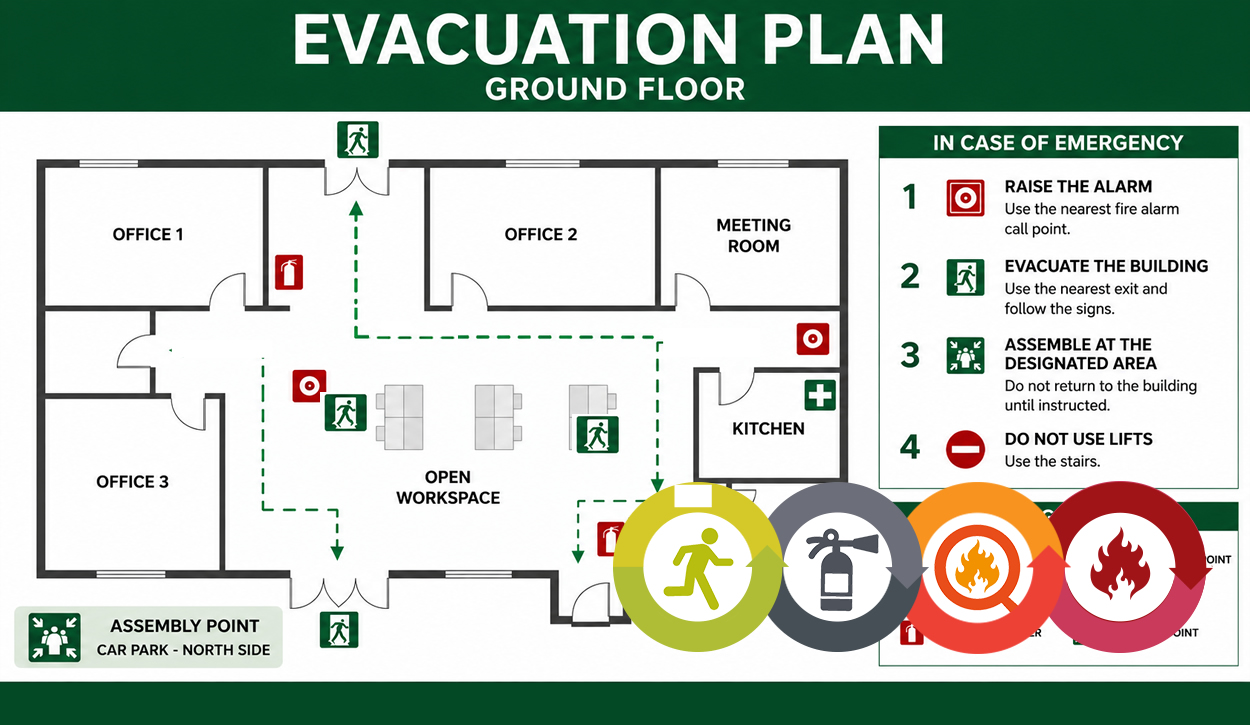
Here is an example of how an evacuation plan might be structured for a typical mid-size office building (e.g. 4 floors + basement), along with rough (hypothetical) timing expectations.
Evacuation Plan Components
- Fire detection & alarm system: Smoke detectors in corridors and common areas; heat detectors in kitchen/plant rooms; manual call-points; central alarm panel.
- Escape routes: Two staircases (if possible), clearly signed, unobstructed, leading to a final exit). Emergency lighting and exit signage throughout.
- Evacuation strategy: Simultaneous full evacuation when alarm sounds, unless fire risk assessment identifies reason for phased evacuation (e.g. high fire risk in certain zones, large building). Assign fire-wardens for each floor, ensure PEEPs (Personal Emergency Evacuation Plans) for any staff/visitors needing assistance.
- Assembly point: A safe, clearly marked location outside the building, a safe distance from exits and fire risk zones.
- Responsibilities & procedures: Who calls fire-brigade, who does sweep-check floors / closes doors, who assists persons with reduced mobility, who verifies escape routes are clear, who liaises with emergency services, who updates log of occupants.
- Maintenance & testing schedule: Weekly alarm tests, monthly visual checks of escape routes, six-monthly professional alarm servicing, annual review of fire risk assessment, evacuation drills at least twice a year.
Hypothetical Evacuation Time Estimates
| Scenario / Floor / Area | Estimated Time to Assembly Point* | Key Assumptions / Notes |
|---|---|---|
| Ground floor (open-plan office) | 30–60 seconds | Alarm audible, clear exit route, no obstructions |
| First floor (single stair, ~15 m travel) | 1.5–2.5 min | Staff desks ≤ 10 m from stair, no congestion |
| Fourth floor (single stair, ~45 m travel) | 3–4 min | Moderate occupancy, stairwell clear |
| Full building evacuation (all floors) single staircase | 6–8 min + pre-evacuation delay | Density moderate; some delay for finishing tasks |
| Full building evacuation — two staircases (one for evac, one for firefighters | 4–5 min + pre-evacuation delay | Effective stair use; good occupant compliance |
*These are indicative only actual times will vary heavily depending on occupancy load, mobility of people, their awareness, time of day (more delays at night), distractions, and congestion.
Tailoring for Type of Industry or Use
Depending on what the commercial property is used for, the evacuation plan should be adapted. Examples:
- Office premises or retail shops: typical simultaneous full evacuation is acceptable. Fire alarms should cover all areas; escape routes clear; staff trained regularly; small occupancy means evacuation likely quick.
- Light-industrial / warehouse / manufacturing: may have higher fire risks (flammable materials, machinery). Detection systems may need heat detectors, manual call-points, possibly suppression systems. Escape routes might need to account for wider corridors, storage layout, hazardous zones; wider staircases or multiple exits might be required. Risk assessment must consider the nature of processes, materials stored, likely locations of ignition.
- Mixed-use or premises with vulnerability (e.g. disabled staff/visitors): plan must include Personal Emergency Evacuation Plans (PEEPs), staff assigned to assist, possibly refuge areas or delayed-zone evacuations, and the escape routes must comply with accessibility standards (suitable door widths, no steps, ramps etc).
- High-rise or large multi-storey buildings: here compliance with more detailed planning requirements (e.g. floor-by-floor plans, building plans, location of firefighting equipment, lifts, smoke control systems) may be mandatory especially under the 2022 Regulations for relevant residential buildings, but analogous good practice applies for mixed/commercial use.
Comparison Table: Example Office vs Light-Industrial vs Mixed-Use
| Feature / Consideration | Medium-size Office (4-storey) | Light-Industrial / Warehouse | Mixed-Use / Office with Assisted-Access |
|---|---|---|---|
| Fire Detection & Alarm | Smoke detectors, manual call-points, central alarm panel | Smoke + heat detectors, manual call-points, possibly suppression system | Combined smoke/heat detectors, manual call-points, alarms, possibly visual alarms or alerts for those with hearing impairment |
| Escape routes & Means of Escape | Two staircases / fire exits: emergency lighting & signage | Multiple exits, wide escape corridors, clear routes around storage/ machinery, emergency lighting | Accessible routes (ramps, wide doors), refuge areas or PEEPs, signage, emergency lighting, possibly seated refuge zones |
| Evacuation Strategy | Simultaneous full evacuation | Simultaneous (or zoned if high hazard zones) | Simultaneous with assisted-evac procedures / phased as per risk assessment |
| Staff Training & Drills | Regular fire drills (≥ twice a year), staff fire-warden roles | Drills, fire-warden roles, training on suppression, safe shutdown of equipment | Drills including evacuation of vulnerable persons, PEEP rehearsals, staff designated for assistance |
| Expected Evacuation Time (typical) | Ground floor: 30–60s; upper floor: ~2–4 min; full building: ~6–8 min | Variable — depends on layout & occupancy; possibly longer if heavy equipment or storage causes obstructions | Slower: evacuation of vulnerable persons or disabled may take longer — maybe 4–10+ min depending on scenario & support |
| Key Risk Controls | Keep escape routes clear; ensure alarm audibility; maintain fire doors & signage | Storage layout planning: ensure flammable materials managed; clear escape paths; suppression if needed | Accessibility planning; PEEPs; refuge areas; regular maintenance; contingency for slower evac |
Practical Recommendations for UK Commercial Property Owners / Managers
- Conduct a comprehensive fire risk assessment (ideally by a competent person or qualified assessor) — revisit it annually or whenever layout/use changes. This is legally required under the FSO.
- Design and document a bespoke fire-action / evacuation plan for your premises — layout, escape routes, alarm systems, staffing roles, assembly points, procedures for assisted evacuation; keep a written copy and ensure staff know where it is.
- Ensure alarm systems, fire detection, firefighting & emergency lighting are appropriate for your building’s size, use, occupancy, and risk profile — and kept maintained & tested regularly.
- Keep escape routes clear, marked, and accessible always. Do not allow storage or obstructions in corridors, stairways, exits. Exit signage and emergency lighting must be in place where needed.
- Train staff and where relevant, have PEEPs for occupants/visitors needing assistance. Run fire drills at least twice a year (more often if high occupancy or vulnerable people).
- For larger / more complex buildings, maintain up-to-date building plans for fire-service use showing lifts, stairwells, suppression controls, escape routes etc (like requirements set out in the 2022 Regulations for residential high-rises). Even if your building is commercial, having updated plans can greatly aid emergency response.
Important Caveats on “Expected Evacuation Times”
- Times vary immensely depending on building design, occupancy, human behaviour, mobility of occupants, and conditions in the event (smoke, panic, congestion).
- Benchmarks like “2.5 minutes to evacuate a protected zone” were developed for residential care homes and vulnerable occupants they are not necessarily appropriate for all commercial settings.
- Data from stairwell evacuation studies show that the number of staircases, stair capacity, and dedicated escape-only stairs dramatically affect total evacuation times.
- Pre-evacuation delay the time between alarm sounding and people starting to move can often form a large part of overall evacuation time. This is unpredictable and needs to be considered in any evacuation planning.
Our team aims to deliver expert customer care, from site survey to completion through to ongoing maintenance. Developing a lasting relationship with a partner you can trust to protect you and your premises whilst ensuring your businesses and organisations are fully compliant to the latest legal requirements. We are CHAS accredited, BAFE registered and, SSAIB certificated with BS EN ISO 9001:2015 & Construction Line approved, so your organisation can be assured that all our fire, security and safety equipment is designed, supplied, installed and maintained in accordance with the latest British Standards.
#FireAlarms #FireRiskAssessment #FireSafetyEquipment #FireAlarmMaintenance #AccessControl #CCTV #SSSystems
