
Comparison Between Wireless & Hard Wired Intruder Alarm Systems
Here is a detailed comparison between wireless and hard wired intruder alarm systems covering their benefits and challenges, plus a look at legislation, British Standard requirements, and practical implications for UK commercial or residential premises.
Overview: What is a Wireless vs Hard‑Wired Alarm System
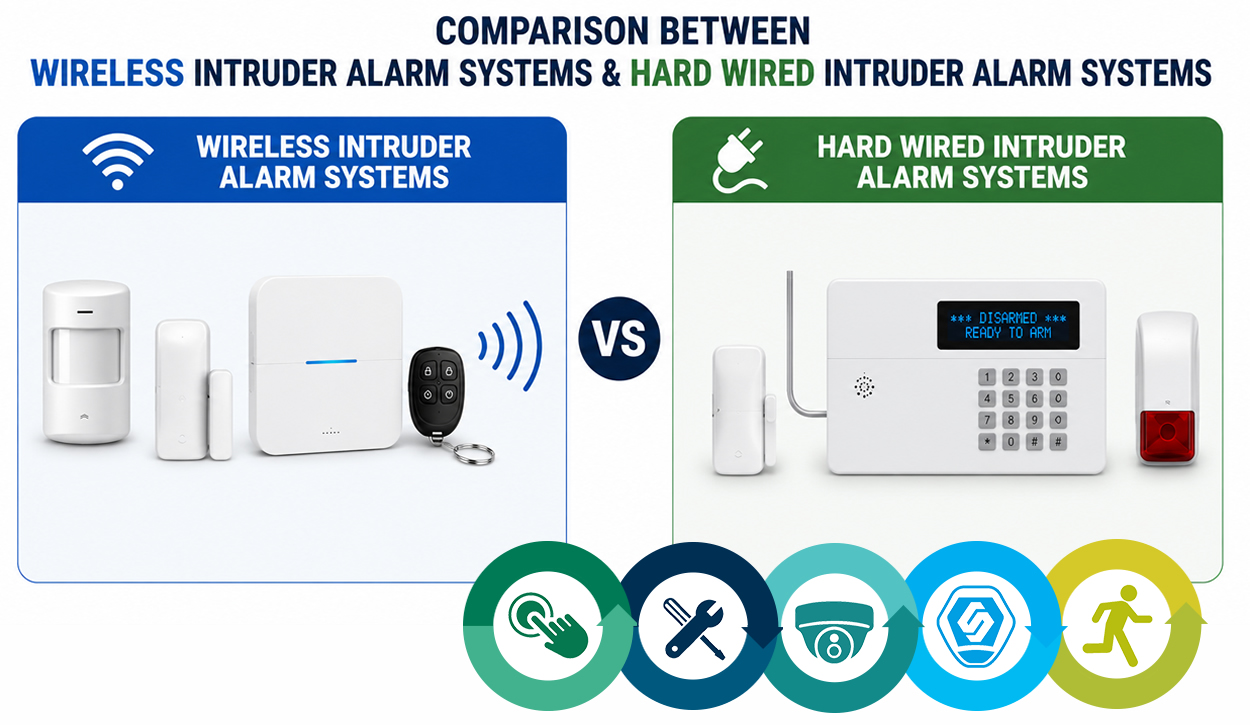
- Hard‑wired (wired) alarm system sensors (door/window contacts, PIRs, glass‑break, etc.) are connected by physical cables to a central control panel, which provides power and communication.
- Wireless alarm system sensors and detectors communicate with the control panel via radio signals (RF), typically battery powered. No (or minimal) cabling is required.
Both types now fall under the scope of existing standards for intruder alarms in the UK.
Benefits & Challenges of Each System Type
Wireless Systems — Benefits
- Easy and quick installation: No need to run wires through walls, ceilings or floors. This reduces disruption, labour, and makes them ideal for retrofit installations, rented premises, or buildings where drilling isn’t practical (e.g. heritage buildings, offices, existing commercial units).
- Flexibility and scalability: Sensors and devices can be repositioned, added, or removed easily. Useful for changing premises layouts or expanding coverage later.
- Aesthetic and minimal disturbance: As no visible cabling is needed, the property’s decor and structure remain intact a plus for offices, shops, or renovated premises.
- Portability: Wireless systems can be uninstalled and reinstalled elsewhere more easily valuable for tenants, short‑term leases, or when relocating.
- Battery‑powered resilience (for sensors): Since many sensors are battery-operated, they may continue operating even if mains power to the building is cut assuming the control panel has backup power.
Wireless Systems — Challenges / Drawbacks
- Battery dependence & maintenance: Sensors need batteries, which must be maintained and replaced. If battery status isn’t monitored and batteries die, coverage could be lost.
- Possible signal interference or reliability issues: Radio communication can be disrupted by structural obstacles (thick walls, metal, concrete), other electronics, or electromagnetic interference. This may cause reduced reliability or false alarms.
- Potentially higher component cost: Wireless sensors and devices may cost more individually than wired equivalents.
- Range and coverage limitations in large or complex premises: For large commercial sites, multiple floors, or highly partitioned buildings, wireless signals may struggle possibly requiring extenders or hybrid solutions.
- Need for ongoing maintenance and testing: To ensure signal integrity, battery status, and sensor connectivity especially important if system is monitored or linked to an Alarm Receiving Centre (ARC).
Hard‑Wired Systems — Benefits
- High reliability and stable communication: Since sensors are connected by cable, communication is less likely to suffer interference or signal drop. More dependable especially for larger buildings or many zones.
- No battery maintenance for sensors: Sensors are usually powered via the control panel, so no need for regular battery replacement (though control panel power backup is still recommended).
- Lower long-term maintenance costs: Once installed, fewer maintenance tasks (no battery changes), more stable over time.
- Better suitability for large or complex premises: For multi-floor buildings, multiple zones, warehouses or commercial sites requiring many sensors cabling ensures coverage without signal limitations.
- More sensor & device variety and compatibility: Wired systems often offer broader device options (e.g., different detector types, glass‑break, shock sensors, environmental sensors) from various manufacturers giving more flexibility in designing a bespoke system.
Hard Wired Systems — Challenges / Drawbacks
- Complex and disruptive installation: Requires running cables through walls, ceilings or floors; may involve drilling, trunking, and structural disruption labour intensive and messy.
- Higher upfront cost and installation time: More materials (cables, trunking) and labour means higher initial outlay, especially in existing or occupied buildings.
- Less flexibility / harder to reconfigure: Once installed, adding new sensors or relocating zones usually means additional wiring work inconvenient and costly.
- Aesthetic impact: Unless cables are concealed neatly, wiring can be visible or require disruptive chasing of walls/floors, which may be undesirable especially in finished or heritage buildings.
- Dependence on mains power (with required backup): While sensors don’t need batteries, the system relies on mains power; a backup battery (or UPS) is required to maintain function during outages.
Legislative & British Standard / Compliance Requirements (UK) Both Wireless and Wired
- The primary standard governing intruder and hold-up alarm systems in the UK is EN 50131 (with UK implementation via PD 6662). This replaced older British Standards.
- EN 50131 sets out security grades (Grade 1 to Grade 4) based on risk, intruder capability, and required system resilience applies to both wired and wireless systems.
- A proper risk assessment must inform the design and the required grade of the system (i.e. you shouldn’t just pick wireless or wired arbitrarily choose based on risk, property type, value of assets, occupancy, layout, etc.).
- For systems requiring professional monitoring or police response, compliance with BS 8243 is often required (for “confirmed alarms” / signalling protocols / communication to an Alarm Receiving Centre (ARC)).
- Installations should be done by accredited companies typically those listed with recognised inspectorates such as National Security Inspectorate (NSI) or Security Systems Alarm Inspection Board (SSAIB), especially if you expect insurance validity or police response.
- Maintenance and servicing must follow recommended schedules; periodic checks are important to ensure system integrity, especially for wireless devices (battery, signal strength) and signalling devices.
Practical Considerations — Which is Better Depends on Use Case
| Use case / Situation | Wired Alarm is Probably Better if… | Wireless Alarm is Probably Better if… |
|---|---|---|
| New build or major renovation | Wiring can be installed during construction, minimal extra cost, better long-term reliability | N/A (wired usually preferred) |
| Large commercial premises / multi‑floor / warehouse / many zones | Need stable coverage over large area; many sensors; long-term reliability; lower maintenance overhead | Only if wiring is impractical but may need hybrid or additional repeaters |
| Rented or leased property, or building where structural changes aren’t allowed | Wired may be burdensome or prohibited; might complicate exit or refurbishment | Want minimal disruption, easy install, removable wireless offers flexibility |
| Need to reconfigure layout or expand or relocate in future | Rewiring would be costly not ideal where flexibility needed | Easy to relocate, expand, adjust sensor placement or zones |
| Aesthetics important (heritage building, retail interiors, offices) | Visible cabling may spoil decor; installation intrusive | Clean look, no cables minimal impact on appearance |
| Cost vs benefits small premises or few sensors | Wired may be overkill, high install cost relative to need | Wireless likely more cost-effective and easier |
Key Risks & What to Watch Out For
- Don’t assume a wireless system is “just as good” you must ensure reliable signal, battery monitoring, and maintenance; otherwise, you may get false alarms or system failure at critical moments.
- For large or complex commercial premises, wireless may struggle structural obstacles, signal dead‑spots, and sensor distance limitations may undermine coverage.
- Whether wired or wireless — the system’s grade, installation quality, and maintenance practices matter far more than simply “wired vs wireless”. A poorly installed wired system with gaps or exposed wiring is worse than a well-implemented wireless system.
- If you rely on police response or insurance coverage, ensure the system is built to EN 50131 / PD 6662, compliant with BS 8243 (if monitored), installed by an accredited company, and appropriately maintained.
- Wireless introduces some unique concerns battery life, signal interference, possible jamming (especially for low-end or consumer-grade systems), so don’t assume “set and forget.”
Conclusion: There Is No One‑Size‑Fits‑All Choose Based on Your Needs
- For large, multi-zone commercial premises or long-term installations where reliability, stability, and low maintenance are priorities a hard-wired system is often the better choice.
- For rented, leased, heritage, retrofit or smaller premises, or where flexibility and minimal disruption are more important a wireless system can be highly effective, provided you manage its limitations carefully (battery maintenance, signal checks, accredited installation).
- The critical factor is not simply “wired vs wireless” but ensuring standards compliance (EN 50131 / PD 6662), correct system design based on risk assessment, accredited installation, and robust maintenance and monitoring practices.
Our team aims to deliver expert customer care, from site survey to completion through to ongoing maintenance. Developing a lasting relationship with a partner you can trust to protect you and your premises whilst ensuring your businesses and organisations are fully compliant to the latest legal requirements. We are CHAS accredited, BAFE registered and, SSAIB certificated with BS EN ISO 9001:2015 & Construction Line approved, so your organisation can be assured that all our fire, security and safety equipment is designed, supplied, installed and maintained in accordance with the latest British Standards.
#WireAlarmSystems #WirelessAlarmSystems #FireAlarms #FireRiskAssessment #FireSafetyEquipment #FireAlarmMaintenance #AccessControl #CCTV #SSSystems
