
Crossover between BS 5839 and Building Safety Legislation
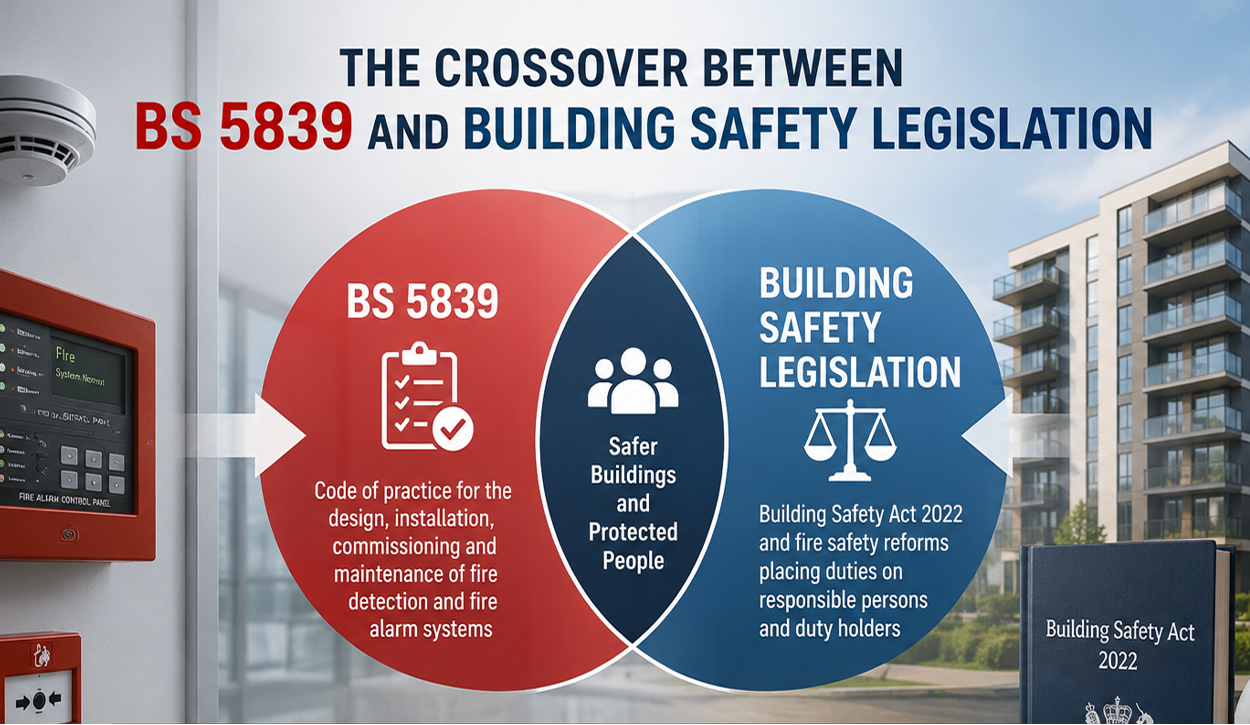
The increasing focus on building safety compliance has highlighted the important crossover between British Standards Institution standard BS 5839 and wider building safety legislation. While BS 5839 provides detailed guidance on the design, installation, commissioning and maintenance of fire detection and fire alarm systems, legislation introduced through the Building Safety Act 2022 and ongoing fire safety reforms has placed greater responsibility on building owners, duty holders and responsible persons to demonstrate effective fire risk management. In practice, this means fire alarm systems must not only meet the technical recommendations of BS 5839, but also support broader legal obligations surrounding occupant safety, evacuation strategies, system maintenance, record keeping and ongoing compliance throughout a building’s lifecycle
- Overview of BS 5839
- BS 5839-1: Code of practice for design, installation, commissioning, and maintenance of fire detection and alarm systems in non-domestic premises.
- BS 5839-6: Code of practice for domestic premises (e.g., houses, flats, HMOs).
- Provides guidance on system categories (L1–L5, P1–P2, M) and installation requirements.
- A code of practice, not law, but widely accepted as the benchmark standard for compliance.
- Building Safety Legislation (UK context)
- Building Regulations 2010 (Approved Document B): Requires adequate means of fire detection and alarm.
- Regulatory Reform (Fire Safety) Order 2005 (RRO): Duty on the Responsible Person to ensure premises are safe; requires fire risk assessments and suitable fire detection measures.
- Fire Safety Act 2021: Extends RRO scope to external walls and flat entrance doors in multi-occupied residential buildings.
- Building Safety Act 2022: Introduces dutyholders (Client, Principal Designer, Principal Contractor, Accountable Person) for higher-risk buildings and the “golden thread” of information.
- Fire Safety (England) Regulations 2022: Specific requirements for multi-occupied residential buildings, e.g., fire alarm testing, wayfinding signage, information to residents.
- Crossover Points
- Fire alarm systems are the practical method of compliance with legislation.
- BS 5839 provides the “how”; legislation provides the “must”.
- Fire risk assessments under the RRO often recommend systems designed to BS 5839.
- The Building Safety Act reinforces the need for records, competence, and maintenance aligned with BS 5839 guidance.
- Approved Document B often cites BS 5839 as a standard for satisfying functional requirements.
- Key Questions to Ask
- Building Use & Occupancy
- Is the premises domestic, non-domestic, mixed use, or higher-risk residential?
- What is the fire strategy and evacuation policy (stay put, simultaneous, phased)?
- Legislative Framework
- Which legislation applies (RRO, Building Safety Act, Fire Safety (England) Regs)?
- Who is the dutyholder / Responsible Person / Accountable Person?
- System Requirements
- What category of fire alarm system (L, P, or M) is appropriate?
- Is the system designed, installed, and maintained in line with BS 5839?
- Is competency of contractors and maintainers verified?
- Information & Records
- Is there a current fire risk assessment?
- Are test, maintenance, and commissioning records available and up to date?
- Does the system form part of the “golden thread” of safety information?
- Best Advice
- Follow BS 5839 as the technical benchmark for design, installation, commissioning, and maintenance.
- Align with legal duties under the RRO, Fire Safety Act, and Building Safety Act.
- Engage competent professionals (third-party accredited installers/maintainers).
- Maintain accurate records—logbooks, certificates, test reports—to demonstrate compliance.
- Regularly review fire risk assessments to ensure system adequacy against changing risks.
- Educate dutyholders (Accountable/Responsible Persons) on their obligations.
- In Summary
The crossover between BS 5839 and building safety legislation is that BS 5839 provides the accepted technical standard for meeting the legal duty to provide and maintain adequate fire detection and alarm systems. Compliance is not optional legislation sets the requirement, and BS 5839 is the recognised route to demonstrate it.
Our team aims to deliver expert customer care, from site survey to completion through to ongoing maintenance. Developing a lasting relationship with a partner you can trust to protect you and your premises whilst ensuring your businesses and organisations are fully compliant to the latest legal requirements. We are CHAS accredited, BAFE registered and, SSAIB certificated with BS EN ISO 9001:2015 & Construction Line approved, so your organisation can be assured that all our fire, security and safety equipment is designed, supplied, installed and maintained in accordance with the latest British Standards.
#FireAlarms #FireRiskAssessment #FireSafetyEquipment #FireAlarmMaintenance #AccessControl #CCTV #SSSystems
